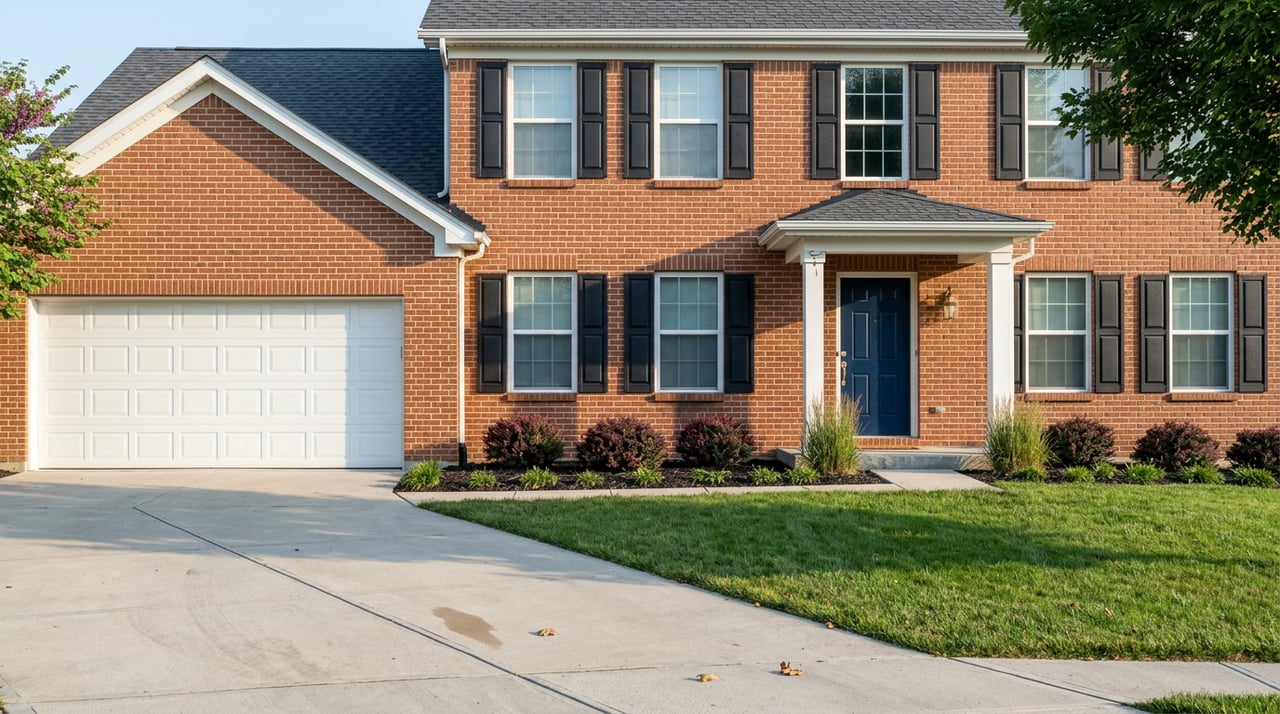
Two numbers came out of Spring Hill this year that should not sit next to each other. Over the three months ending in May 2026, the median home sale price climbed 5.3 percent year over year to $542,000. In January 2026, single-family closings fell 45 percent compared to the year before, dropping from 64 sales to 35, while months of supply crossed into buyer's-market territory at 7.05.
A market where prices rise and sales collapse in the same season is not describing two different trends. It is describing one number that is quietly measuring two different things. If you are comparing Spring Hill to another Middle Tennessee suburb right now, the median price on its own will mislead you, and the reason has almost nothing to do with how much homes are worth.
One City, Two Governments
Spring Hill sits across a line most buyers never think to ask about. According to JVM Lending, the bulk of the city falls in Maury County, with a northern slice in Williamson County. That line determines which school district a house feeds into: Summit High School under Williamson County Schools on one side, Spring Hill High School under Maury County Public Schools on the other.
The city itself has to work around a legal quirk to make this arrangement function at all. Tennessee's constitution requires that everyone in the same taxing jurisdiction be taxed at the same rate relative to actual value. Williamson and Maury counties reappraise property on different schedules, so their assessment ratios drift apart between cycles, and a single flat city tax rate would tax the two sides unequally in practice even if the rate looked identical on paper. Spring Hill has managed this for years by running a technically split city tax rate, adjusted to the ratio between the two counties, a workaround detailed in a University of Tennessee County Technical Assistance Service memo prepared for the city.
That same memo points out something specific to right now: the two counties' reappraisal cycles only realign once every twenty years, and the next alignment falls in 2026. As Williamson Scene reported, in 2022, Spring Hill's aldermen used a temporary window in the ratio to equalize the city-only portion of the rate at 73.9 cents per $100 of assessed value on both sides, a fact confirmed on the city's own tax rate page. But the county levies underneath that city rate fund Williamson County Schools and Maury County Public Schools.
What that means for a buyer is simple and easy to miss: two homes a few streets apart, both carrying a Spring Hill address and a 37174 ZIP code, feed different school systems. The single ZIP code is not a single market.
The Plant's Unsettled Stretch
Spring Hill's other economic anchor had its own unsettled stretch in 2026, and single-family closings also fell that year.
Ultium Cells, the battery joint venture between General Motors and LG Energy Solution, built a 2.8-million-square-foot plant in Spring Hill originally meant to supply battery cells for the Cadillac LYRIQ and other GM electric vehicles. Earlier this year, GM shifted part of that plant's output away from EV batteries entirely. The company began a roughly $70 million retooling to produce lithium iron phosphate cells for grid-scale and data-center energy storage instead, a pivot driven by cooling EV demand and surging electricity needs from AI data centers. The retooling idled part of the workforce before GM recalled about 700 previously laid-off workers by the end of April 2026 to staff the new production line.
"We're able to transition this capacity to a new business opportunity in rapid short order." — Ultium's vice president of operations, quoted by GM Authority
The comment framed the pivot as a sign of the plant's flexibility rather than its fragility. But flexibility announced in March does not erase the uncertainty that preceded it. The January housing data offer a separate view of buyer timing.
Look at how buyers behaved in January 2026, at the height of the plant's realignment. The average time from listing to signed contract stretched from 60 days to 75, a 25 percent increase. But once a buyer actually committed, the deal moved faster than it had a year earlier: average time from contract to closing dropped from 58 days to 38, a 35 percent decrease. Buyers weren't dragging their feet during due diligence. They were dragging their feet before they ever made an offer.
The figures show that the longer wait came before an offer, but they do not identify why buyers waited.
Why the Median Kept Climbing Anyway
The two patterns can be considered alongside each other, but the available figures do not show that plant-related uncertainty caused particular buyers to wait.
The January 2026 numbers show the mix of sales by price. Of the 42 total closings that month, 24, or 57 percent, were priced under $500,000, concentrated in Maury County communities like Harvest Point, Chapmans Retreat, and Wyngate Estates. The lower end of the market was still active. It just shrank by more than the upper end did. When a smaller, differently weighted pool of homes closes each month, the citywide median moves even if no individual home changed in value. The median reflects what actually sold, not what every house is worth, and a shift in the mix of homes that sell can move the number even without broad appreciation.
That is one possible way to reconcile the figures, not a proven explanation. The mix of homes sold can affect the median, but these figures alone do not show that it accounts for the price increase.
What This Means If You're Comparing Spring Hill to Somewhere Else
If you're cross-shopping Spring Hill against Franklin, Nolensville, or another Middle Tennessee suburb, don't put the citywide median in a spreadsheet next to theirs and call it apples to apples. Ask which side of the county line a specific listing sits on before you do anything else with the price. That single question answers another: which school district the address feeds into.
For sellers, the lesson runs the other direction. A longer time-to-contract right now doesn't mean buyers aren't serious. It means they're taking longer to decide before they act, and once they do, they close on schedule. Pricing with patience through that longer decision window may serve you better than pricing aggressively and hoping for a fast offer that matches 2022 timelines.
A Few Direct Questions
Does a listing show which county it's in? Not always at a glance. Spring Hill's single ZIP code, 37174, covers both the Williamson and Maury County portions of the city, so confirming the parcel's county and school zone is worth doing before comparing two homes that look similar on paper.
Is the Ultium Cells plant still cutting jobs? The reporting through spring 2026 pointed toward recovery rather than further reductions. The retooling toward energy storage cells brought roughly 700 previously idled workers back onto the payroll by the end of April 2026.
What does the 2026 reappraisal alignment resolve? It resolves the scheduling mismatch that has forced Spring Hill to run an adjusted city tax rate across the two counties for years.
Spring Hill rewards buyers and sellers who read past the headline number, and that's exactly the kind of read a concierge relationship is built for: knowing which side of a county line matters before you write an offer, and which market signal is noise. CHORD Real Estate works Middle Tennessee's suburbs at this level of detail every day. Request your personal Real Estate Concierge and let's map out what a specific address, on a specific side of Spring Hill, actually means for your move.
This article is general information, not legal, tax or financial advice. Consult a qualified professional about your situation.